

Map is not a territory: Every best practice has its limitations.
Mental models in practice, episode 6


Have you ever tried to assemble furniture by following the manual? If yes, I am pretty sure that in some cases, you couldn’t make it work, even if you followed the steps one by one. This happens because manuals, guidebooks, and other tools are only descriptions of reality, not reality itself.
Famous philosopher and engineer Alfred Korzybski coined the phrase: “Map is not a territory” to illustrate the limitations of the fact that models represent things but are not identical to those things. A map can help you find the way, but the way itself may be different than expected.
Why is it important to know that? Because, especially in business, we like to follow particular approaches, methods, or frameworks to combat our challenges. Think of Agile, Design Thinking, Double or Triple Diamonds, Canvases, Net Promoter Score, or any other best practices we try to implement. While doing that, we must remember that even the best methods have limitations. So, as much as we would like to follow them by the book, we should make necessary adjustments on the fly. How can we do that?
A map is not a territory, but you still need it anyway. So, draw one before you start implementing new solutions. You can do that by looking into several factors, such as:
Expected goal: What is the current goal of the solution?
Outcome: What do you expect to see in the end?
Must-haves: Which parts of implementation can't be omitted or changed?
Progress: How will you measure the progress?
Change log with reasoning: What changes were applied in the process? Why each change was made?
Example: Implementing Net Promoter Score
Let’s use one example to show the advantage of using the “Map is not a territory” mental model in practice.
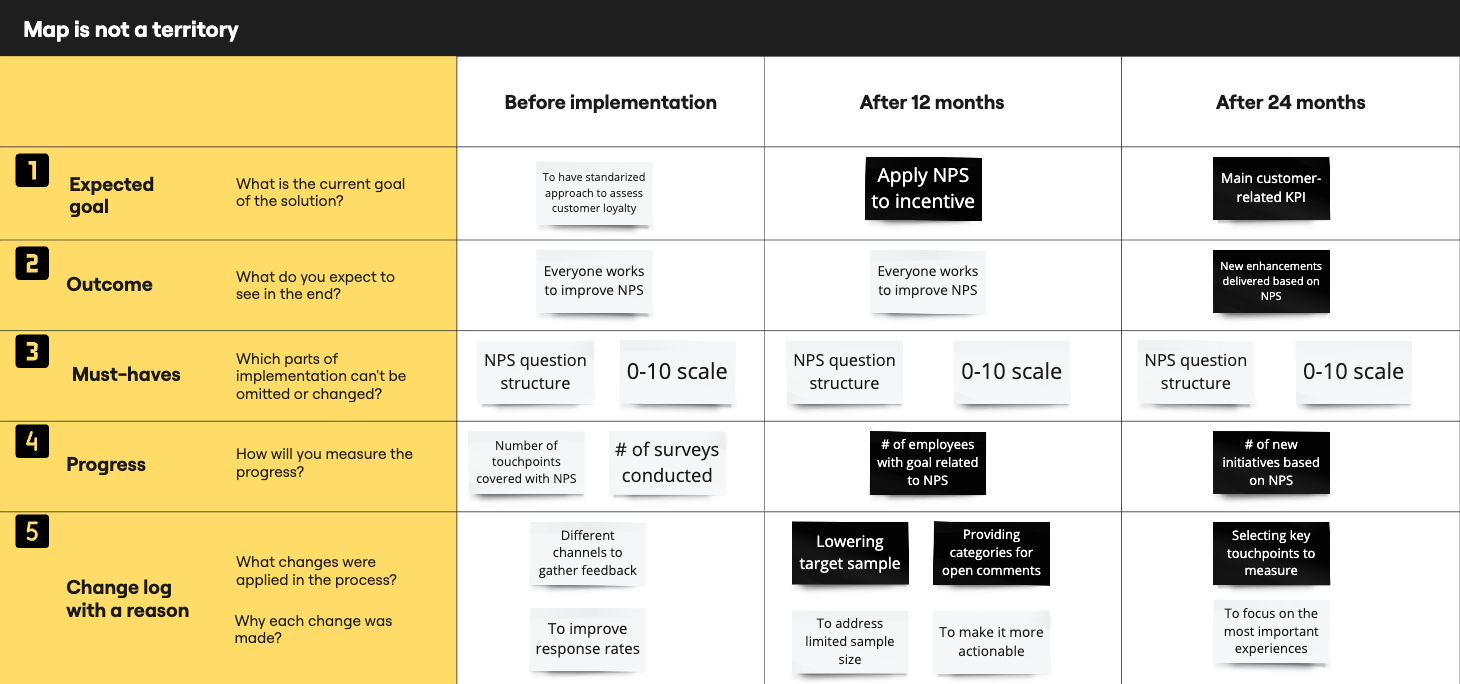
An excellent way to think about this mental model is to accept that, in reality, everything constantly changes. As you read through the upcoming story, pay close attention to subtle shifts in context across time.
Imagine that you are about to implement Net Promoter Score to measure customer loyalty. The company wants to do that so all employees can focus on customers’ experience and work on it with a standardized approach to measurement. Your initial focus is to implement processes around gathering feedback to ensure you provide material to work on.
Yet, as time flies by, strategies evolve, too.
After another 12 months, you go back to the drawing board with an attempt to calibrate the approach to NPS. You can see the strategy evolved, and currently, your work is focused on creating goals for employees that take NPS scores into account. You simplified the operational work around the metric by implementing the category choice to the open comment question. That ensured that actions could be taken quickly.
Fast forward another 12 months. And surprise, surprise — another change is required.
This time, a program of features and fixes is being rolled out based on customer feedback. As the work related to NPS evolved again, the expected goal and outcome also changed.
Pro Tips:
A map should be filled in in a table with separate time frames (e.g., Before, After 6 months, and After 12 months) to verify initial assumptions against the current situation.
Do a must-haves section with special care. It should feature an analysis of which components of the implementation are the most valuable.
What is it in for me?
At this point, you may ask what this example teaches us. In short, use the guidebook of the solution you want to implement only in the beginning (“before the implementation” section). The rest is about putting this to work in natural conditions and applying the changes necessary for the company.
One sentence to remember
“Map is not a territory” teaches us that copying best practices step-by-step is hardly ever possible, and we should be open to making the necessary changes.